8 months of one-word answers. A closed bedroom door. A dinner table with an empty chair. A teenager who laughs with friends and gives you silence. A phone hidden when you walk in. Every attempt to reach him pushed him further: the questions he wouldn't answer, the conversations he endured, the space that became permanent distance. That was knocking on a door that only opens from the inside. Now the approach changes. Stop Knocking reduces the pressure. Parallel Presence rebuilds proximity without demand. Side-Door Conversations create openings through shared activity instead of forced interrogation. The Listening Reset ensures that when the door cracks open, your response keeps it open instead of slamming it shut. The door opens from the inside. The method makes the hallway safe enough for your child to want to open it.
"The door doesn't open from the outside. Make the hallway safe."
"My teenager is pulling away. That hasn't changed yet. What has changed is how I stand in the hallway. Not knocking. Not demanding. Not hovering. Present. Available. Without pressure. The chin chin is on the counter. The kitchen smells like jollof rice. I am here. I expect nothing. And somewhere behind that closed door, my child knows the hallway is safe. The door will open. From the inside. When they are ready. And I will be here when it does."
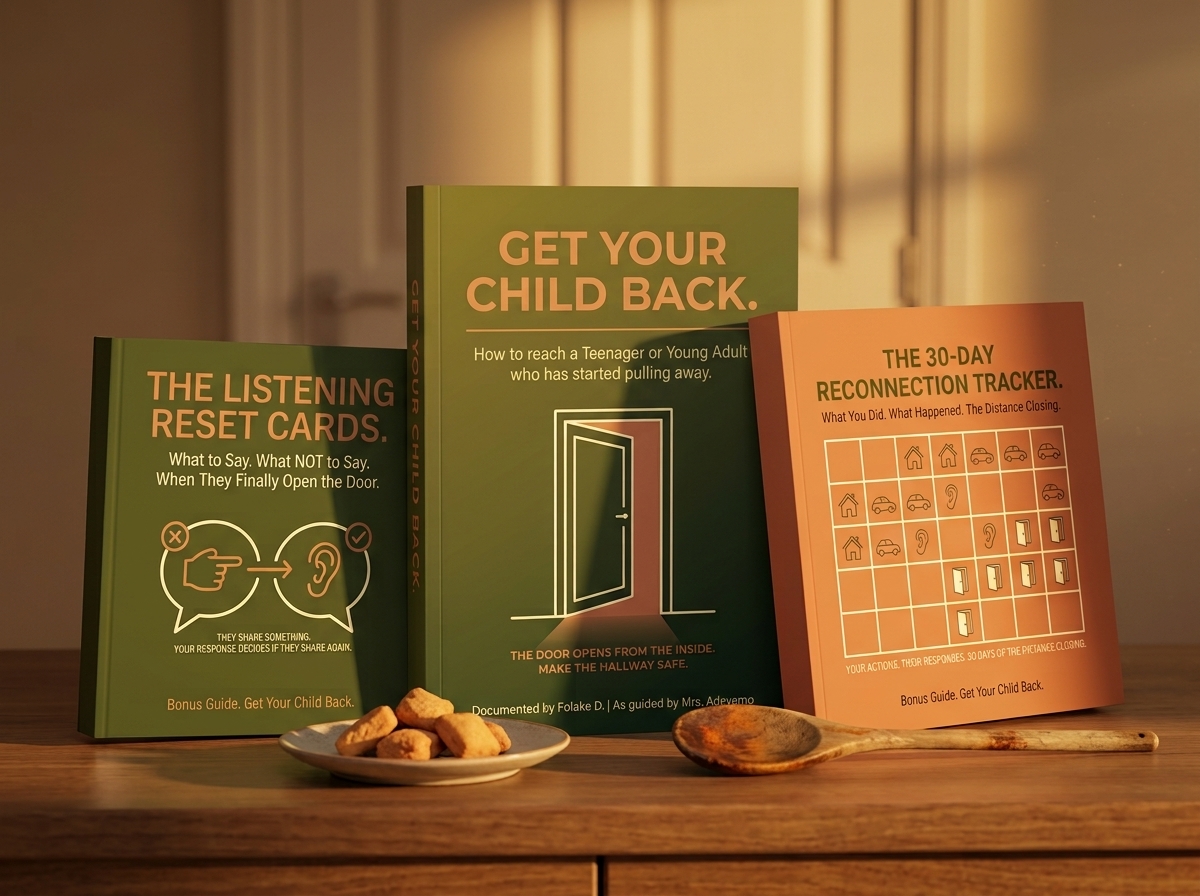
Your Method Is Ready
Click below to download the complete method and both bonus guides instantly.
Download Your Guides NowHere's What You Got
Stop Knocking (the pressure release). The Parallel Presence Practices (proximity without demand). Side-Door Conversations (in the car, in the kitchen, while walking). The Listening Reset (when they open, how to respond so they stay open). The New Connection (the relationship at 16 is not the relationship at 10)
Printable response frameworks for the 5 most common things a teenager might share: school stress, friendship problems, romantic interest, identity questions, and fear. What to say. What NOT to say. Keep them in your pocket
Daily log: what you did (parallel presence, side-door, nothing). What happened. Any shift. 30 days of data showing which approaches YOUR child responds to. The tracker reveals the pattern
Your First 48 Hours
Download Everything Now
Tap the button above. Save all 3 files. The main guide is your complete reconnection system. The Listening Reset Cards go in your pocket for when the moment arrives. The Tracker starts tomorrow.
Read "Stop Knocking" Tonight
Open the guide. Read Step 1: Stop Knocking. This is the counterintuitive foundation. Your instinct is to push harder: more questions, more confrontation, more "we need to talk." The method explains why every push builds the wall higher, and what to do INSTEAD. By tomorrow morning, you will approach your teenager differently. Not with less care. With a different kind of care.
Tomorrow: No Questions
This is your Day 1 action. Do not ask "How was school?" Do not ask "Are you okay?" Do not ask "What's wrong?" For one day, replace every question with a statement or an offering. "There's food on the counter." "I'm watching something in the living room if you want to join." No question mark. No expectation of a response. This is the pressure dropping. Your teenager will feel the difference even if they don't show it.
Start the Reconnection Tracker (Bonus #2)
Open the tracker. Day 1 entry: What did you do? (Stopped asking questions. Made an offering without expectation.) What happened? (Maybe nothing visible. That is okay. The pressure dropped. The hallway is beginning to feel different.) Log it. Every day for 30 days. The pattern emerges by Day 10-14.
Read the Listening Reset Cards Now (Bonus #1)
Read them now, before the moment arrives. When your teenager does open the door and shares something, your response in the first 10 seconds determines whether they share again. The cards prepare you for the 5 most common scenarios. Read them now so when the moment arrives, you are ready to receive instead of react.
What to Expect
Do This Right Now
Open the guide. Read "Stop Knocking." Understand why the pushing doesn't work. Then put something on the kitchen counter. Chin chin. Fruit. A snack they like. Don't call them. Don't announce it. Don't say "I left something for you." Just put it there. Walk away. If they take it, say nothing. If they don't, say nothing. The offering is the first act of a safe hallway. No expectation. No strings. Just: you are welcome here.
"The door doesn't open from the outside. Make the hallway safe. Start with the counter. Start with the offering. Start tonight."

Need Help?
Not sure how to start Stop Knocking? Need guidance on Parallel Presence for your specific situation? Question about a Side-Door approach? Every message answered.